

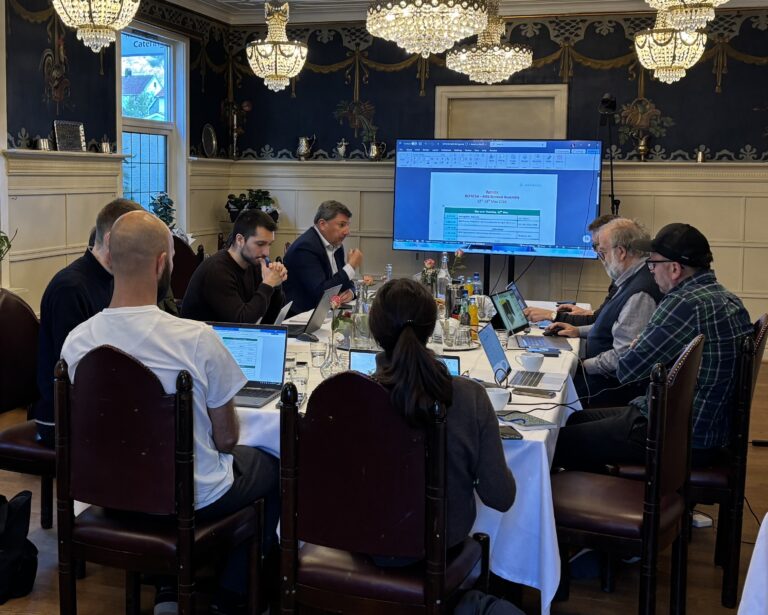
Day 1 of the REFRESH General Assembly.
The REFRESH partners met in Norway on 12-13 May for the project’s M41 General Assembly, hosted by Gjenkraft. With just six months to go, the project is gaining momentum as we see the concept become reality.
Recycling technologies
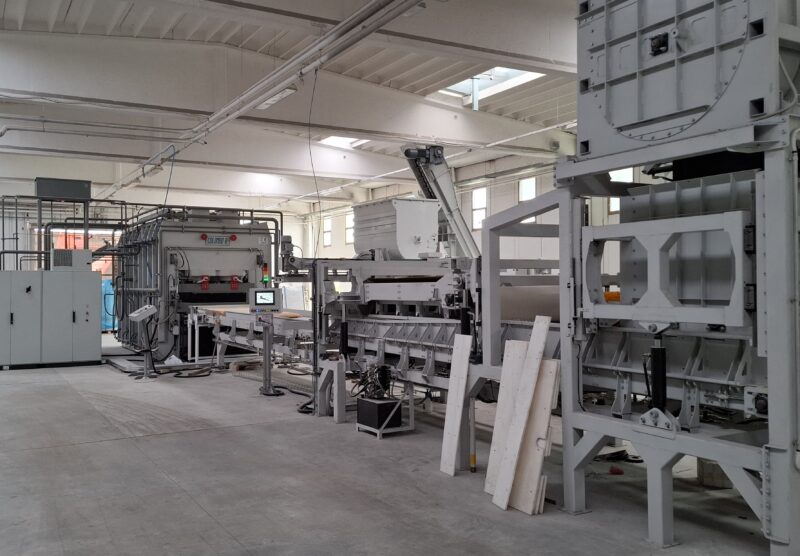
There’s strong progress to report in all areas. Gees Recycling’s mechanical recycling plant in Aviano, Italy, and Gjenkraft’s thermal recycling line in Høyanger are both nearing the end of their commissioning phases.
The Gees production line, which includes a new 6400-ton hot press, is producing high performance panels which are potential alternatives to MDF and plywood. The recycled panels with a phenolic resin coating also offer impressive fire resistance with low smoke emission, as well as excellent insulation properties, corrosion resistance, and durability. The panels have numerous potential applications including:
- Building shading facades and architectural components: 70% lighter than concrete, with 96% recycled content;
- Cold chain/freezer components: good insulation and no thermal bridges, corrosion resistant, 96% recycled content;
- Formwork: a complete system interchangeable and compatible with standard components, 40% lighter than aluminium, 70% lighter than iron, corrosion resistant, 90% recycled content.
- Battery storage systems, cladding for houses, cabinets for electrical equipment …
Gjenkraft’s advanced thermal treatment process enables the recovery of glass fibres, carbon fibres and synthetic fuels, and will have an annual capacity of approximately 2,800 tonnes/year.
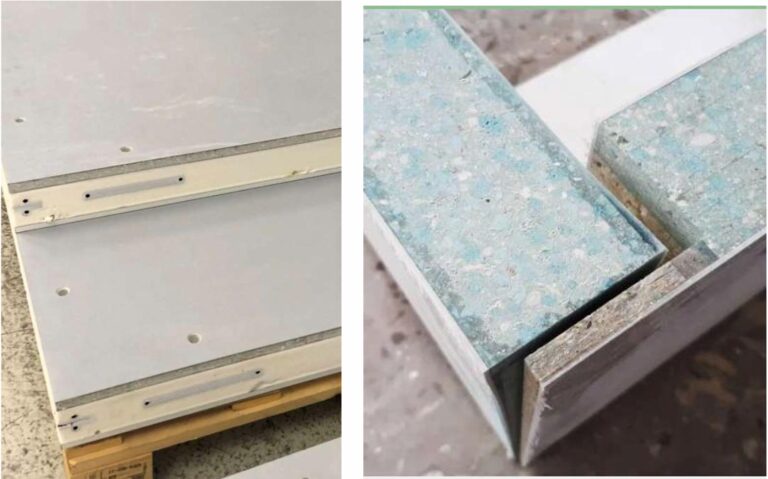
Gees panels as cold chain/freezer components.
CIRCE continues to assess and optimise its microwave (MW)-assisted pyrolysis and solvolysis technologies for recycling composites from blades, which enable the recovery of glass fibres and complex oils that could be used either as fuels or chemical building blocks. Compared with conventional pyrolysis/solvolysis processes, microwave-assisted heating offers a number of advantages:
- fast, selective and volumetric heating;
- enhanced control over pyrolysis process and oil product distribution;
- lower apparent processing temperature for a given depolymerisation extent.
Enecolab is refining its GEOW® thermochemical process for converting the dust and fines inevitably generated during composites recycling into syngas and inert materials. The objective is to maximise the gas fraction (energy carrier). The GEOW process is designed to be integrated into an industrial process to minimise and to inertise the waste and to recover the energy content.
New products incorporating recycled materials
CETMA’s work to develop applications for recycled materials is moving ahead. Numerical validation of the mechanical performance of the circular blade prototype incorporating thermally recycled glass fibres is ongoing, and a vertical wall formwork using panels produced through mechanical recycling has been designed.
The TECNALIA team is developing a cement-based material for 3D printing that incorporates recycled fibres and designing a scaled (1/10) wind turbine tower to assess its performance.
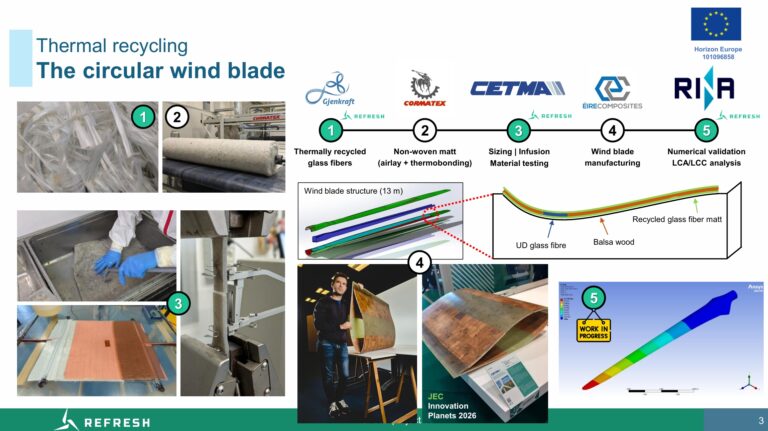
The circular blade incorporating recycled glass fibres.
The REFRESH repurposing strategy is also advancing. An addition to the picnic table already demonstrated, a new structural application is under development. This is a crash cushion, which will make use of sections recovered from 45 m blades recently dismantled onsite by ETAT9 using its smart cutting solution.
In addition, ACCIONA Construction is exploring ways of using recycled materials in products for the construction industry. It is currently developing three demonstration products prototypes. The company’s ultimate goal is to prove that it can replace virgin materials with recycled alternatives without sacrificing structural integrity. By doing so, it will be transforming blades into high-value assets for the global building and construction industry, fully realizing the circular vision of the REFRESH project
Traceability and sustainability
The beta version of TECNALIA’s blockchain traceability platform launches for testing soon.
This will enable the traceability of blades from the wind farm to the products in which recycled
materials are used, ensuring transparency and
sustainability across the entire value chain.
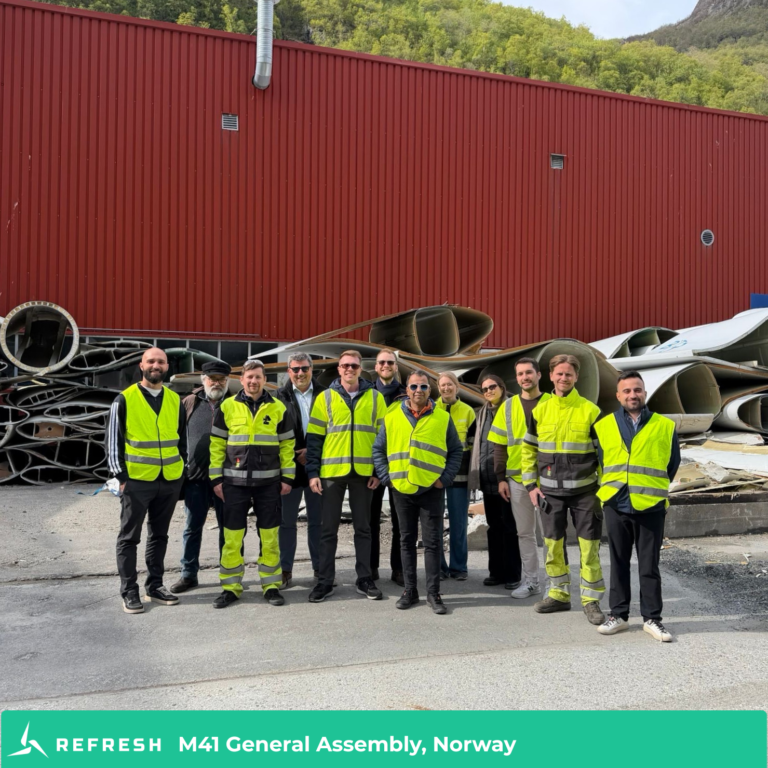
The REFRESH team at Gjenkraft’s Hoyanger plant on 12th May.
Sustainability lies at the core of everything REFRESH is doing. In parallel with process demonstration and testing, and digital platform development and prototype design, RINA is leading LCA and LCC analysis across the value chain, as well as creating eco-label certification guidelines for products derived from composites recycled from blades.
An initial LCA of the project’s processes for recycling glass fibre and carbon fibre reinforced composites from end-of-life blades highlights significant environmental benefits for the REFRESH mechanical recycling and thermal recycling processes compared to traditional disposal methods, including a reduction in climate change impacts of >70% for the thermal processes compared to incineration.
Stakeholder workshop
This progress was showcased during the project’s second stakeholder workshop From End-of-Life Blades to Circular Products – Technologies, Prototypes and Market Pathways held on the second day of the General Assembly.
For those unable to join online, the workshop presentations will be uploaded to our website and a recording of the event available on the REFRESH YouTube channel.
Gjenkraft thermal recycling plant
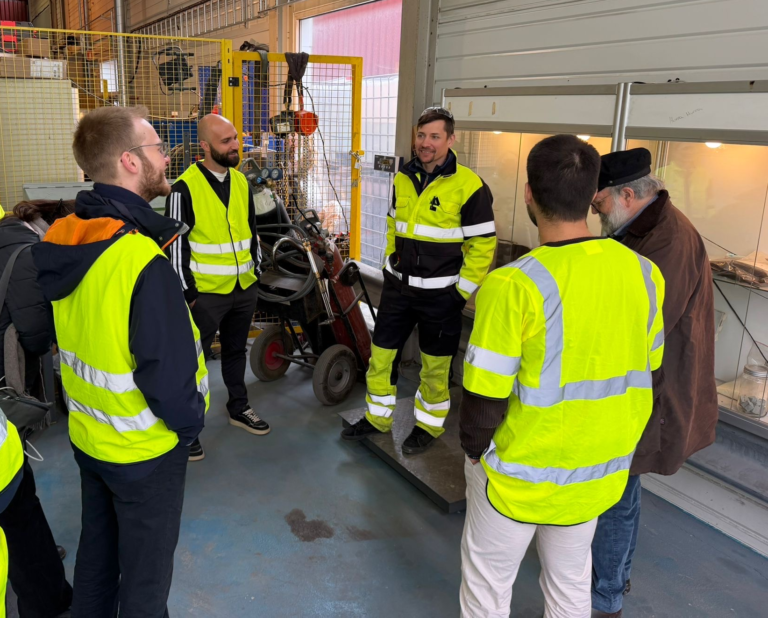
Inside the Gjenkraft plant.
Another highlight of the meeting was a visit to Gjenkraft’s recycling plant, where the progress made since our first visit in 2024 for the M18 General Assembly was clearly visible.
Gjenkraft’s recycling process enables the recovery of glass fibres and the company is developing partnerships to design new products using these fibres. Examples include a project with Norwegian ski manufacturer EVI and Swedish company Vattenfall to manufacture skis using recycled carbon fibres, and a collaboration with Owens Corning signed in October 2025.
A big thank you to the Gjenkraft team for showing us around the new line and for their hospitality during this second visit, as well as to all partners who joined us in person and online.
More updates coming soon – stay tuned!
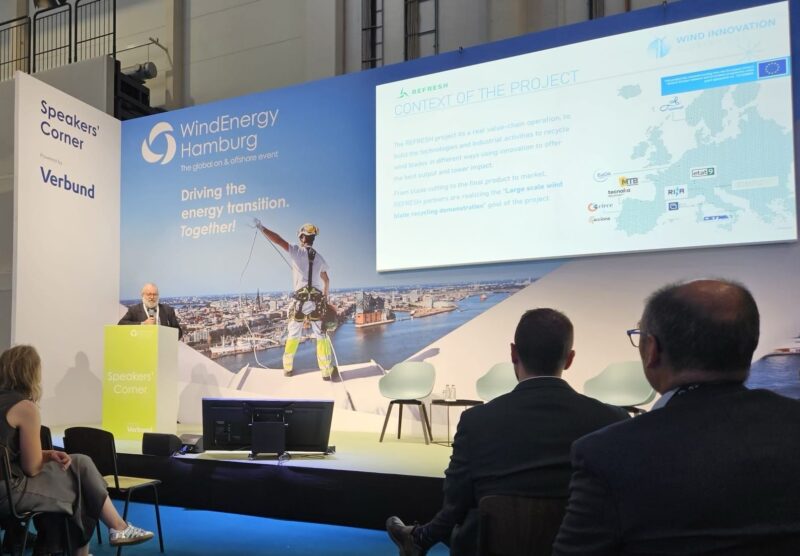
Gees Recycling presents REFRESH at WindEnergy Hamburg
REFRESH participates in WindEnergy Hamburg as member of Wind Innovation Cluster Hub